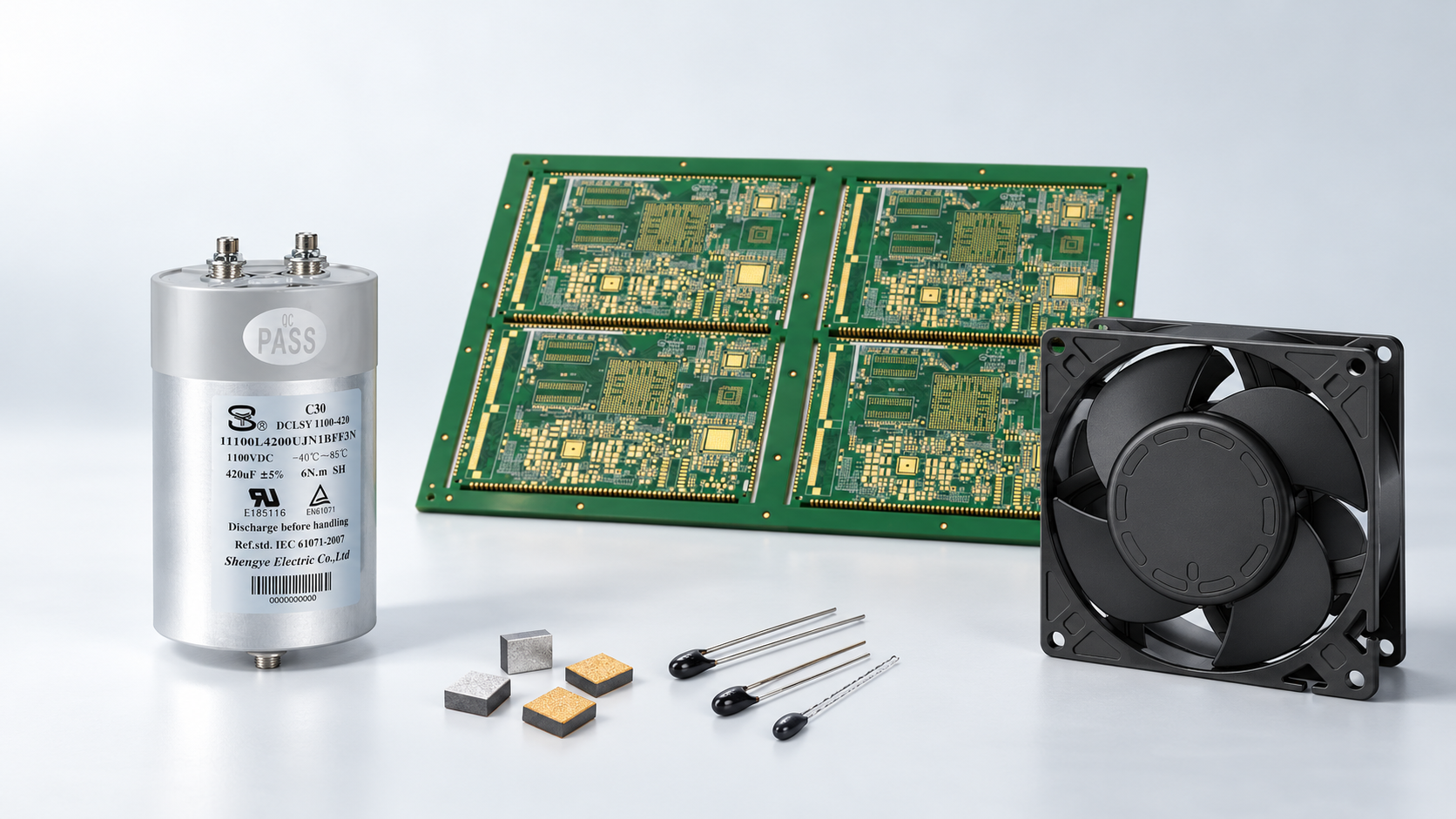
AI-assisted editorial composition based on manufacturer imagery. Separate product examples, not a tested assembly; not to scale.
At a glance
SINOVAlink connects industrial requirements with specialist manufacturing capabilities. This article examines five partners: Sheng Ye Electric for film capacitors; CCHV (Shenghui Technology) for cooling fans; Sendwin Electronic / Dickson Circuits for multilayer PCBs; EXSENSE Electronics for NTC temperature sensing; and LJV Technology for precision housings.
The three applications explored are power conversion, equipment thermal control and optical communications hardware. The practical starting point is a shared equipment brief, followed by component selection and application-specific engineering review.
A hardware programme can have a capable supplier for every part and still lose time where those parts meet.
The capacitor fits the electrical specification, but crowds the board. A higher-output fan solves one thermal constraint while changing noise, power draw and the space available to the rest of the assembly. The temperature sensor is accurate at its sensing element, yet its placement and response time determine how useful the reading will be.
For equipment developers and procurement teams, these are linked decisions. They need to be examined before drawings, tooling and qualification plans become expensive to change.
Within SINOVAlink’s manufacturing partner network, Sheng Ye Electric, CCHV, Sendwin / Dickson Circuits, EXSENSE and LJV bring different capabilities to this problem: film capacitors, airflow, printed circuit boards, temperature sensing and precision structures. Digital infrastructure provides a useful way to see where these capabilities meet, across power equipment, cooling assemblies and optical communications hardware.
APPLICATION MAP
Start with the equipment. Then connect the capabilities.
Three engineering conversations that bring different specialists into the same project.
01
Power conversion & continuity
UPS · power converters · auxiliary power
SHENG YE Film capacitors+SENDWIN Power & control PCBs+CCHV / EXSENSE Cooling & sensing
SHARED REVIEW
Ripple current, layout, temperature and service life.
02
Equipment-level thermal control
Server enclosures · power shelves · controls
CCHV Air movement+EXSENSE Temperature feedback+SENDWIN Control-board fabrication
SHARED REVIEW
System resistance, sensor location and control response.
Mechanical fit, heat transfer and application-specific board requirements.
Capability relationships for project scoping. Component selection and system qualification are specific to each design.
01 / POWER & CIRCUIT BOARDS
Review the electrical design and the physical layout together.
In a power converter, capacitor selection influences packaging, temperature and connection design. The PCB adds another set of choices: copper weight, insulation distances, material, stack-up and manufacturability. Resolving each in isolation can send the same design back through several suppliers.
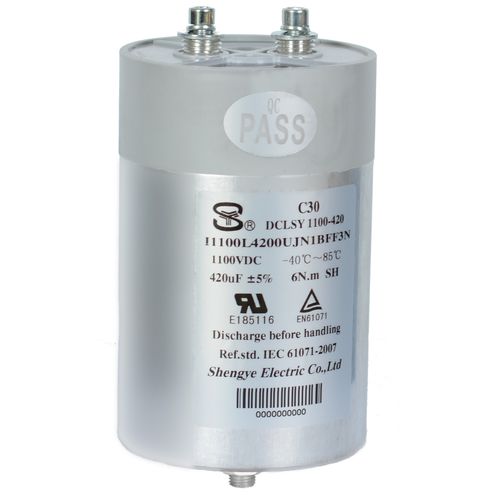
Sheng Ye DCL series. Manufacturer catalogue image.
SHENG YE ELECTRIC
Film capacitors for power electronics
Sheng Ye’s portfolio includes DC-link, AC-filter and snubber capacitors. Its published applications include UPS equipment, inverters and industrial drives. That breadth makes the operating conditions the right starting point for selection.
Bring the DC-bus voltage, ripple-current spectrum, ambient and hot-spot temperatures, envelope and target life into the same review.
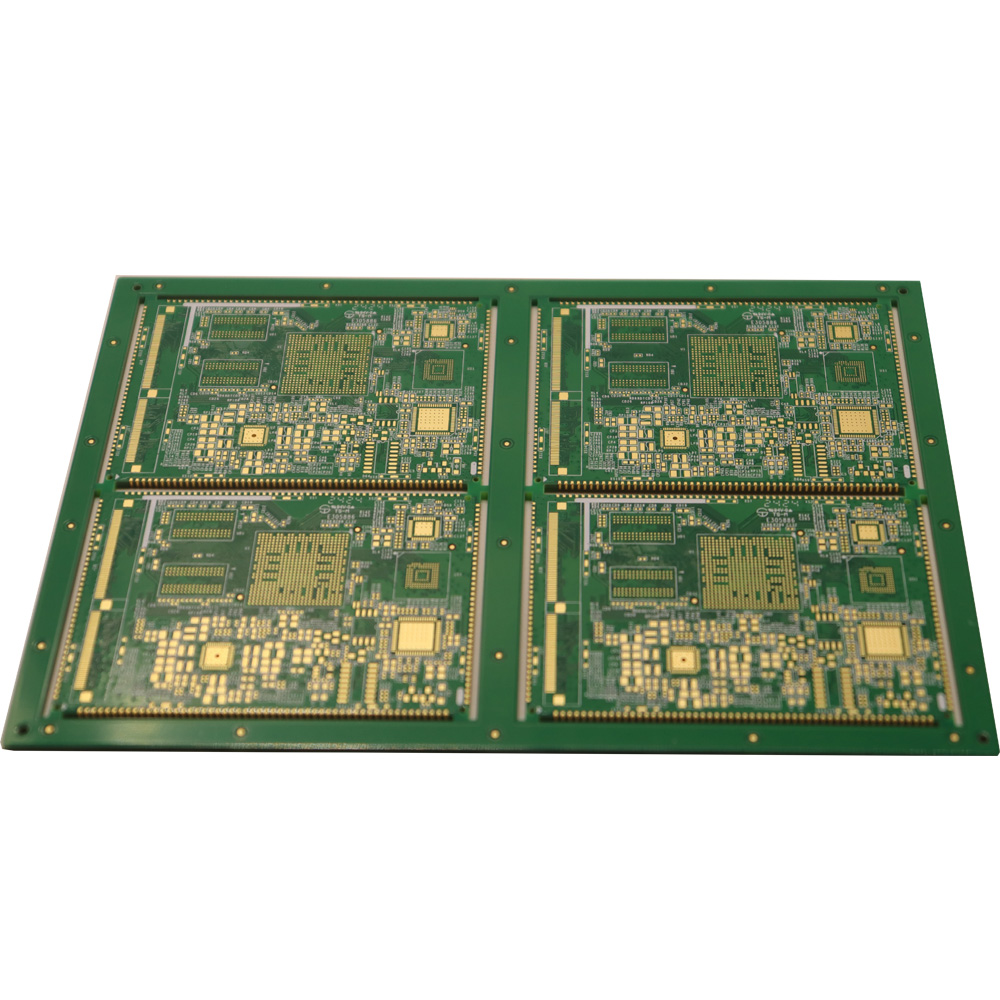
Sendwin / Dickson telecom PCB example. Original manufacturer image.
SENDWIN / DICKSON CIRCUITS
The board is part of the engineering decision.
Sendwin / Dickson brings multilayer bare-PCB manufacturing, including heavy-copper and telecom designs. One published telecom example, 8G20414A1, uses an eight-layer FR-4 Tg170 construction, ENIG finish and a 0.15 mm minimum hole size.
Those details give an engineering team a concrete starting point for a fabrication discussion. For a power board, the conversation moves to copper, temperature rise and insulation; for a high-speed board, stack-up, materials and impedance requirements come to the fore.
Model 8G20414A1. These values describe this product example.
02 / AIRFLOW & TEMPERATURE
Cooling capacity and temperature feedback belong in one conversation.
A fan’s free-air rating is only one input to enclosure cooling. Filters, heatsinks, cable routing and openings create resistance. Sensor placement then determines what the control system can see. Changing the fan without reviewing the sensing arrangement can leave the original hot spot poorly understood.
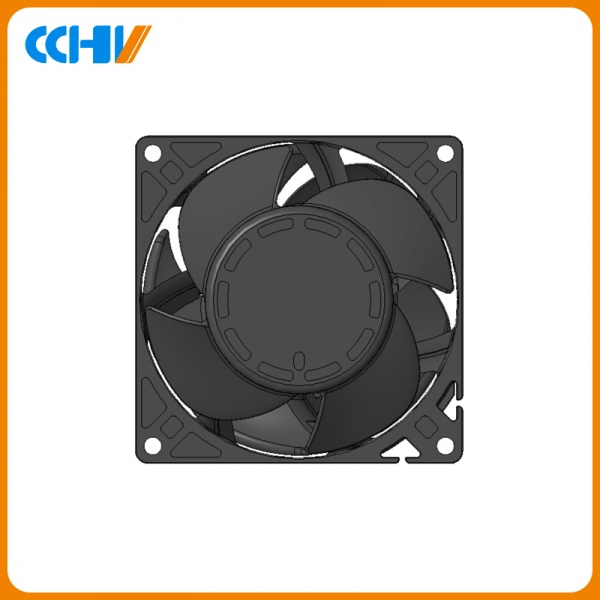
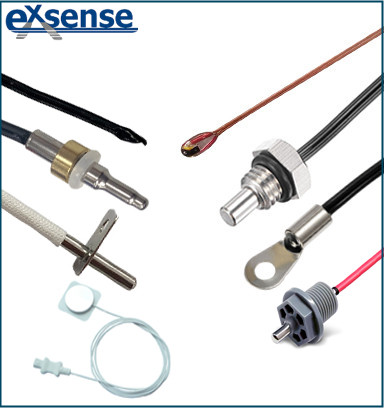
CCHV 8080 series B, official product rendering.EXSENSE NTC sensor family. Packaging examples.
CCHV
Air movement matched to the enclosure
CCHV develops axial, centrifugal, blower and double-motor fan products. Its catalogue includes the 8080 series B double-motor fan and a dedicated server-application category.
A useful selection discussion starts with the required operating point on the airflow-pressure curve, followed by acoustic limits, supply voltage, control signals and environmental conditions.
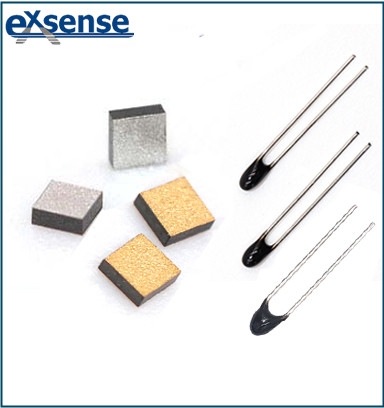
EXSENSE works across NTC chips, thermistors and packaged temperature probes. It also describes NTC sensing for liquid-cooled servers, connecting a small component to a much larger thermal-control task.
Probe packaging, response time, the resistance-temperature curve and mounting position all matter. Sensor accuracy becomes useful when the assembly and control logic can act on the reading.
Where does the heat accumulate, how is it removed, and where will the system measure the change?
03 / OPTICAL-MODULE PRECISION
The housing participates in the thermal design.
Optical communications brings mechanical and thermal constraints into a small space. The housing has to locate and protect the internal assembly while supporting the intended heat-transfer path. Tolerances and contact surfaces deserve attention early in development.
LJV
Precision manufacturing for optical-module structures
LJV’s published QSFP housing example is made from zinc alloy and lists a minimum wall thickness of 0.35 mm. Its wider manufacturing capabilities include tooling, die-casting, stamping and injection moulding.
This gives optical-hardware teams a specific route into a mechanical-design conversation: material, wall geometry, tooling constraints, surface finish and the critical assembly interfaces.
Minimum wall thickness listed for LJV’s zinc-alloy QSFP housing.
THIN-WALL PRECISION
Process capability illustration. Not an engineering drawing.
EXSENSE chip and thermistor examples.
Small components, shared constraints.
EXSENSE’s NTC sensing and Sendwin / Dickson’s telecom PCB capability add adjacent disciplines to the discussion. For a particular optical module, the team still needs to define the sensing point, board material and stack-up, mechanical interfaces and validation plan together.
Beginning with the assembly requirements helps distinguish the capabilities worth investigating from those that merely share an industry label.
04 / WORKING THROUGH SINOVALINK
One project brief. The right technical conversations.
For an OEM or equipment integrator, the useful output is a clearer development decision: which manufacturers fit the requirement, what information is still needed, and what should be tested before committing to tooling or production.
SINOVAlink can help frame that work across its manufacturing partners. A component brief becomes a capability shortlist; drawings and operating conditions become focused questions for the relevant engineering teams. Sample planning, qualification responsibilities and supply arrangements can then be defined for the project.
AI supports the research and comparison work. Engineers resolve the application questions, and commercial teams agree responsibilities. The aim is to carry the original requirement through those conversations without losing the details that matter.
01
Define the requirement
Application, constraints, existing part or drawing, destination market.
02
Bring in the specialists
Relevant capabilities, technical questions and interface dependencies.
03
Agree the next evidence
Design review, samples or tests, with clear ownership and scope.
The value of a manufacturing network becomes visible when it helps a project make its next engineering and commercial decision.
ENGINEERING & SOURCING QUESTIONS
Before the first technical review.
Can SINOVAlink coordinate a requirement involving several manufacturers?
Yes. SINOVAlink can help define the brief, identify relevant manufacturers and coordinate the technical and commercial discussions. The project should establish who is responsible for each component, interface, sample and qualification step.
What should we provide for an initial component review?
Start with the equipment application, operating conditions, the existing part or drawing, the target market and expected quantities. For thermal components, include the enclosure and airflow constraints; for a PCB or housing, identify the critical dimensions and interfaces. Confidential files can be exchanged through an agreed process after the initial conversation.
How do we evaluate a second source or replacement component?
Define the required electrical, thermal and mechanical performance, along with certification and reliability requirements. The relevant manufacturer can then assess candidate products and the sample or test evidence needed. Compatibility, lead time and supply terms are established for the selected part and project.
START WITH YOUR APPLICATION
What are you building or trying to improve?
Tell us the equipment, the component or constraint, and where the project will be delivered. We can start with a single part or a requirement that crosses several disciplines.
Have a confidential drawing or BOM? Describe the application first; we can agree how to exchange technical files.
About this series Capabilities in Context connects manufacturing expertise to real equipment and market questions. Each edition explores a different application across SINOVAlink’s partner network.
Product examples are drawn from the manufacturers’ published information. Specifications, certification scope and supply arrangements are confirmed for the selected product and project. Original product images remain credited to their respective manufacturers.
An AI-native Industrial House
Industrial strength. Growth across markets.
Rooted in Chinese industry. Working across markets.